Showing posts with label James J. O'Donnell. Show all posts

Tuesday, February 2, 2010

The Fall of the West: The Death of the Roman Superpower by Adrian Goldsworthy

Adrian Goldsworthy, The Fall of the West: The Death of the Roman Superpower    (Weidenfeld & Nicolson, 2009) 531 pages Verdict?: 4/5 A compelling contribution in a closely-contested field.

 Those of us interested in the fall of the Roman Empire have had a surfeit of riches over the last five years.  In 2005 we had both Peter Heather's The Fall of the Roman Empire: A New History of Rome and the Barbarians and Bryan Ward-Perkins' The Fall of Rome: And the End of Civilization.  Then last year we got James J. O'Donnell's The Ruin of the Roman Empire: A New History (reviewed here) and Christopher Kelly's The End of Empire: Attila the Hun and the Fall of Rome. So just when we could be forgiven for thinking that no more good books on the subject are likely to appear for a while, Roman history heavyweight Adrian Goldsworthy enters the ring with a 500+ page tome that goes the distance with all of the above.

Goldsworthy's book not only draws on the work of the other scholars mentioned, particularly Ward-Perkins, but it is also a counter and response to them as well, and he has Peter Heather in his sights in particular.  Heather's book was the first major narrative history of the collapse of the Western Roman Empire seen for many years.  The story he tells has all the elements of a ripping yarn - wars, court intrigues, barbarian invasions, battles, plots, assassinations - and, as an unabashed Germanicist myself, I could not help but be compelled by his emphasis on the centrality of the barbarian invasions in the whole affair even while never quite being convinced by his argument.  Because Heather's version of the story, simply put, says the Empire did not crumble from within but was crushed from without.  According to Heather, the Empire in the late Fourth Century was essentially strong, the Army large and highly effective and things were generally stable.  But then the arrival of the Huns triggered a cascade of events that sent large, highly-militarised Germanic peoples crashing into the borders of the Empire.  The Eastern half coped largely by diverting these people westward and so the West was eventually overwhelmed and collapsed.

Goldsworthy, however, is having none of this.  Noting both Bryan Ward-Perkins and Heather's recent books he writes:

Each of these books is extremely good in its own way, but both are restricted in what was possible to cover.  Neither makes much effort to link the empire of the fourth century to the earlier empire.  Yet this connection needs to be made if we are to understand more fully what the Roman Empire was like and discern why it did eventually fall. (Goldsworthy, p.21)
He then spends the best part of the first half of his book making precisely this connection and, in the process, calling into serious question the basis of Heather's argument: that the Empire of the Fourth Century was essentially stable, solid and secure.

The Calamitous Third Century or "Who's Emperor Now?"

One of the reasons Heather is able to present the Fourth Century as comparatively stable, solid and secure is that the Third Century was anything but.  While Heather and Ward-Perkins both begin their accounts in the late Fourth Century, on the eve of the epoch-changing Battle of Adrianople, Goldsworthy takes his story all the way back to the death of Marcus Aurelius in AD 180.  The accession of his feckless and, ultimately, disastrous son Commodus marked the end of the long period of peace and stability of the Antonine Dynasty and the beginning of almost one hundred years of civil war, usurpers, rebellions, fragmentation, and multiple emperors known as "the Crisis of the Third Century" or, more succinctly, "the Military Anarchy".  Goldsworthy argues persuasively that what happened to the Western Empire in the Fifth Century can only be understood in the context of the turmoil of 200 years earlier.

And he tells the story of the turmoil well, while at the same time carefully laying the analytical foundations of the argument of the second half of his book.  Things were already on a downward slide when Alexander Severus succeeded his bizarre, possibly insane and ultimately assassinated cousin Elagabalus in AD 222.  But they went from bad to worse when he was challenged for the throne by Maximinus Thrax and then unceremoniously murdered in AD 235.  What followed was pure chaos.  In the next 20 years the Roman Empire was to have no less than 20 and possibly as many as 25 different emperors in rapid succession  - often several at a time, which is why it is hard to pin down the actual number.  In fact, this section of Goldsworthy's book becomes something of a bewildering succession of rising and falling emperors, with sometimes two or three succeeding to the purple only to be assassinated by the Praetorian Guard within a single paragraph.

By AD 258 the chaos had got to the point where the Roman Empire had broken into three independent pieces: the provinces of Gaul, Spain and Britain split from the Empire in the west while the provinces of Syria, Palestine and Egypt formed the "Palmyrene Kingdom" in the east, with the rump of Rome between the two.  Aurelian managed to pull things back together during his five year reign before he too was assassinated.  He was followed by no less than six more emperors in nine years before some measure of real stability was finally imposed by Diocletian.

As interesting as this rapid cavalcade of emperors, usurpers and assassinations is, Goldsworthy uses it to make pertinent points about the two centuries which followed and which led to the fall of the Empire.  Firstly, he notes how barbarian invasions are a symptom of Roman weakness and instability, not a cause of it.   Over and over again during the Third Century renewed bouts of Roman civil strife invited larger and deeper raids by barbarians over the Rhine and Danube.  This culminated in the massive land and seaborne raids on the eastern Empire by large Gothic and Herulian warbands in the AD 260s that was only finally brought to an end by Claudius II Gothicus in AD 269.  That this barbarian reaction to Roman weakness - the Empire was at the lowest ebb of the Third Century crisis at the time - is a clear prefigurement of the later barbarian incursions and settlements in the west in the Fifth Century is a point that Goldsworthy makes very clearly.

Secondly, he notes that the "reforms" which are often said to have stabilised the Empire and brought the "Military Anarchy" to an end actually weakened it in the long run.  He points out that the Empire was and had always been a military dictatorship.  Augustus had created it out of years of civil war by winning the struggle for military supremacy.  But what he created was what Goldsworthy refers to as "a veiled monarchy".  Though he was a military dictator who won control by force of arms, Augustus and his First and Second Century successors created a facade whereby they (and everyone else) pretended they ruled by consent, particularly by the consent of the Senate and the Senatorial class.  In return, trusted Senators could receive relatively powerful (and rich) provincial governorships and other honours.  The whole arrangement worked well and was in some ways inherently stable.  The small number of Senators with any real power - ie ones who controlled rich provinces with large armies - could be carefully chosen and the remainder stayed in Rome where they could be carefully watched.  The only major instability was the fact that while everyone was pretending that the emperors were not really kings, the whole idea of the succession to the throne-that-was-not-meant-to-be-a-throne was a murky one.  Despite this, civil wars were rare in the first two centuries of the Empire and the whole system worked.

But when it broke down in the Third Century the veil was torn off and the Imperial system was exposed as the military dictatorship it had always been.  So now it became clear that any Senator who could win the support of enough of the Army or, failing that, who could simply bribe the increasingly mercenary and predatory Praetorian Guard, could become emperor, albeit (in most cases) very briefly.  All it took was a reverse in a foreign war against the resurgent Sassanid Persians or the increasingly bold Germanic barbarians and a usurper would appear or the Army or the Guard would mount an assassination and the whole process would repeat itself, seemingly on a shorter and shorter cycle of usurpation, civil war and anarchy.

This cycle became so intense that the primary goal of a Roman emperor was no longer wise rule and stability but mere survival.  As the Third Century progressed changes were put in place - changes that were aimed solely at reducing the threat of usurpation.  Senators were gradually excluded from military commands, since a Senator with a sizeable portion of the Army at his back was a usurper in waiting.  But by giving more and more commands to the lower, equestrian order the emperors simply pushed the opportunity for usurpation down the Roman food chain and actually broadened the numbers of those who took it into their heads to jostle for the purple.  The size, and therefore the garrisons, of the provinces were steadily reduced, since this left a governor of any given province with fewer troops with which to mount a challenge.  But this in turn weakened the Empire militarily and strategically, since a governor no longer had the military force to deal with serious local threats himself.  Incursions over the frontiers by barbarians increased in size and number and only the Emperor had the capacity to deal with them.  Cities which had been unfortified for centuries began building walls for protection, both against barbarians and against the next cycle of civil wars.

So while these and similar changes - often called "reforms" - brought the Crisis to an end, Goldsworthy makes a strong case that in the longer run the Empire was weakened and that the seeds of the collapse of the Fifth Century were sown in the chaos of the Third.

 The Fourth Century - Recovery?

Thus the greater stability of the Fourth Century, from the long reign of Diocletian onwards, is according to Goldsworthy, something of an illusion.  The cycle of constant usurpation and assassination slowed, but it did not stop.  The concentration of military power in the hands of the emperor meant civil wars were fewer, but the sheer size of the Empire meant there was always going to be a subordinate somewhere with sufficient troops to mount a challenge.  Diocletian recognised that no emperor could protect himself by concentrating power in his hands and still rule a territory as large as Rome's effectively, so he created the tetrachy - four subordinate rulers to whom he could delegate authority and military power.  While this seemed fine in theory, in practice the tetrarchs were soon at each others' throats and Diocletian had to come back from cultivating cabbages in retirement to restore order.  Constantine solved that problem by eliminating his brother emperors and ruling alone, but his successors showed that it took a powerful and utterly ruthless individual to do this and before long the informal division of the Empire into eastern and western halves became increasingly formal and, eventually, permanent.  By the end of the Fourth Century the Eastern and Western Empire were increasingly going their separate ways and this was always going to be bad news for the poorer and less populous West.

Goldsworthy is very cautious about making claims about things for which we have scanty evidence.  Grandiose claims have been made about the economy of the later Roman Empire, for example.  But he is careful to note that we simply do not have the data to draw any clear conclusions about the role of the economy in the collapse of the West because we simply do not have enough information.   That said, it is clear that a divided Empire, however much more  manageable it was in the short term, was always going to be less powerful and stable in the long run.  And it was always likely that the less prosperous and less populated Western half was going to have the harder time bearing the burdens of a large army and expensive defences against external threats.

But Goldsworthy also makes it clear that the seeds of the final Fall were sown way back in the Third Century, took root in the supposed "recovery" of the less chaotic Fourth Century and bloomed into inevitable disaster in the calamitous Fifth Century.  Because the reaction of the emperors of the Fourth Century to the upheaval of the previous era was to centre their rule around one thing: survival.  The army was reorganised not simply to defend against invaders and to operate against the Persians, but also to do so without giving generals or provincial subordinates sufficient individual military power to mount a challenge for the purple.  Likewise provinces became smaller not with a view to administrative efficiency (they vastly increased the local bureaucracies in fact), but to decrease the power of their administrators.  So paranoid were Fourth Century emperors about usurpations that a mere hint of disloyalty could spark purges of whole families, informers and spies thrived on rumours and a good way to get rid of someone you disliked was to imply they had designs on the Imperial throne.  Owning anything that so much as looked like Imperial regalia could get you killed, which led to some comical scenes where actual usurpers had to be robed in a cloak of patched-together purple military pennons or crowned with a lady's necklace because having the real items to hand would be too dangerous.

The other way the emperors insulated themselves from the threat of usurpation and assassination was by retreating physically.  This not only meant emperors became increasingly remote figures in inaccessible courts, shielded by layers of courtiers, functionaries and court ceremonial and ritual, but also that by the early Fifth Century the Western Emperor had withdrawn to the well-defended but remote city of Ravenna and ran his dwindling Empire through powerful chamberlains and commanders-in-chief.  It was only a matter of time before the Western Emperor increasingly became little more than a symbol and figurehead and the powers behind the throne became the real players. 


Not with a Bang, But a Whimper

The final third of Goldsworthy's book tells the story of the end - the last 76 years of the Western Roman Empire when things began to unravel and then spiralled increasingly out of control until total collapse was inevitable.  The narrative elements are familiar enough from other treatments of the story from Hodgkin to Heather - the irruption of the Vandals, Alans and Sueves over the frozen Rhine in the beginning of the century, the Visigoths and Burgundians going from settled federates to rebels to political players in their own right, the last desperate defence against Attila's raids, the abandonment of Britain and the loss of Africa and, finally, the deposition of little Romulus Augustulus.  The strength of Goldsworthy's treatment lies in how he ties this accelerating spiral of loss of control to the trends that had their roots in the "Military Anarchy" of the Third Century.

With the Western Emperor now so insulated from potential usurpation that he was effectively politically marginalised, court functionaries and supreme commanders - the Magister Militae - battled for real power.  That is, when they were not fending off the claims of a new wave of usurpers, who appeared to challenge for the dwindling power of a shrinking Western Empire.  At several key points the West was too busy fighting civil wars to defend itself and all too often warbands of invaders - themselves usually fairly small - moved into territory unopposed.  Some provinces were deliberately or effectively abandoned by the military, such as Britain and northern Gaul.  In other cases warbands, such as that of Alaric, were preserved rather than crushed so as to use them as a cheap source of trained troops.  Either way, the effect was slow but accelerating loss of territory which, once Africa was lost to a (small) band of Vandals, became impossible to reverse.

Goldsworthy also has some scorn for the idea that the later Western Roman Army was as large as some modern writers make out.  He has little time for those who take the units listed in the famous Notitia Dignitatum at face value, arguing that this was simply an idealised listing of units that, by that stage, largely existed on paper.  Here Goldsworthy the primarily military historian is worth paying some attention to:

At times, when reading descriptions by modern historians of warfare in this period, it is difficult to avoid the image of Hitler in his last days, planning grand offensives on a map with divisions that had long since ceased to exist. (Goldsworthy, pp. 289-90)
He notes that territories which, according to the Notitia, should have been garrisoned with powerful elite units of comitatenses, such as Spain, are crossed and recrossed by barbarian warbands seemingly at will.  The internal struggles of the Western Empire took up what real troops remained, as effective as they were, and the paper units of the Notitia could not defend Britain or retake Africa.

In the end the distractions of civil war and usurpation meant that an already weaker and poorer Western Empire was nibbled at its edges and then from within by barbarians, who had always taken advantage of Roman weakness.  Finally the loss of territory meant there was no money and no army to hold even what was left together.  The emperorship became so debased that the last puppets who held the title were barely worth deposing.  Even the once coveted supreme military title of magister utriusquae militiae became not worth keeping - the Burgundian prince Gundobad rose to this rank, but gave it up to pursue royal power amongst his tribe instead.  When the last emperor, the teenager Romulus Augustulus, was finally deposed he was considered so worthless and harmless that he was not even seen as worth killing.  He was given a pension and sent to live with his relatives in the country.  The once great Empire of the Romans no longer existed because no-one saw it as worth maintaining.

This is an excellent book and one, even though it comes after a succession of excellent books on the subject, that will be hard to top for some time to come.  Leaving aside the fact that it is a fine narrative history, Goldworthy brings an outsider's eye to the period, coming to it without the assumptions of a Late Antiquity specialist.  But as more of a specialist in the beginnings of the Empire, he brings an interesting perspective to its end.  This book is both a reply and, at the same time an equal counterweight to Peter Heather's equally excellent work and I would encourage anyone who read, enjoyed and was convinced by either one to read the other.  I think they would profit from the exercise.

Thursday, June 18, 2009

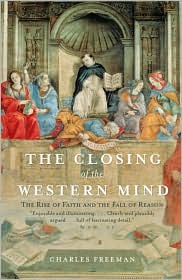
The Closing of the Western Mind by Charles Freeman


Charles Freeman, The Closing of the Western Mind: The Rise of Faith and the Fall of Reason

(Pimlico 2003, Vintage 2002) 470 pages
Verdict?: Fundamentally flawed 2/5

At one point late in the process of working my way through Freeman's dense and exasperating book something struck me about the works he was using to support his argument, so I stopped reading and turned to his bibliography. It is a respectable 16 pages of excellent scholarly works on topics as wide-ranging as the origins of Christianity to ancient Greek astronomy and from Neo-platonism to the conversion of the Empire. But the books that were remarkable by their absence were precisely the ones I was looking for. Here was a weighty, closely-argued tome that was trying to explain the death of reason and its consequent absence in the early Middle Ages (at least, apparently, until the age of Aquinas in the Thirteenth Century) and yet nowhere in his bibliography could I find anything on early Medieval philosophy, Medieval science or Medieval thought generally. Given the excellent recent work done on the continuity between Classical, Hellenistic, Roman, Late Antique and Medieval thinking by giants in the field like David C. Lindberg and the even more important (and relevant) work done on Medieval attitudes to reason by Edward Grant, this gaping hole in Freeman's bibliography was astounding.

But it did explain many things about the book itself, because Freeman's work is, like his bibliography, full of weird absences, strange gaps and unexplained holes. His writing is fluid and his argument is smooth, so it is hardly surprising that most of his readers are blissfully unaware of these odd lacunae. Indeed, Freeman carries even readers who are aware of what he is not telling us along so fluently that it required me to stop several times and say to myself "But hang on a minute, what about ... ?" And that's because I am fairly familiar with the material he covers already. So it is hardly surprising that non-specialist reviewers accept his thesis without so much as blinking and that most general readers have been even more readily convinced. At several key points in his argument I felt like someone watching a stage magician at work - you know what he is showing you is not the whole story, but the illusion is so smooth it's easy to blink and miss the deception.

Roman "Tolerance"

Several times before on this blog I've reviewed works that cover the beginning of the Dark Ages, though in this one the barbarians so central to writers like Wickham and O'Donnell (below) barely get a mention. The barbarism that Freeman laments is a specific one and it's certainly not the Goths and Vandals who are responsible for the vandalism:

The argument of this book is that the Greek intellectual tradition did not simply lose vigor and disappear. (Its survival and continued progress in the Arab world is testimony to that). Rather in the fourth and fifth centuries AD, it was destroyed by the political and religious forces which made up the highly authoritarian government of the late Roman empire.
(Freeman, "Introduction to the Pimlico Edition", xvii)

Consequently the bulk of his 450+ pages is a reasonable summary of the development of Classical natural philosophy, its basis in reason, how it fared in the Hellenistic and Roman periods and the rise and development of Christianity from a Jewish sect to an Imperial state religion. On the whole this summary of history is judicious enough and covers a broad range of topics and centuries in enough detail to avoid being glib and rapidly enough to avoid getting bogged down.

The points where his narrative jars for anyone with more than a passing familiarity with the subject matter is where Freeman skips around something that might not suit his picture of Classical and Roman thinking as generally free, untrammelled and superbly rational and later thinking as restricted, oppressed, constrained and (finally) strangled. Freeman makes ancient medicine sound as though it bordered on the rigour of its modern equivalent, for example. Yet it was as riddled with silliness, superstition, astrology, mysticism, false assumptions and quack cures as anything in the Middle Ages and Renaissance. It was a highly irrational ancient taboo about corpses that prevented any genuine examination of human anatomy - with the exception of one short window in which human dissection was allowed in Ptolemaic Egypt, anatomical knowledge came from guesswork, observations of screaming patients during surgery and the dissection of apes, dogs and pigs. Not surprisingly, this rather irrational way of working did not exactly yield much useful information. And ironically, this taboo was overcome and true dissections were carried out again in the Middle Ages.

Similarly, Freeman makes much of the supposed religious tolerance of earlier Roman imperial authorities and contrasts this with the increasingly intolerant attitudes of Constantine and his successors to the purple:

(T)here clearly existed a wide range of spiritual possibilities, any one of which could be followed without any sense of impropriety and, even though there existed some degree of competition between the different movements for adherents, none excluded other beliefs.
(Freeman, p. 75)

This bucolic image is very pretty and highly appealing. And, as a marked rhetorical contrast to the later Imperial campaigns for religious orthodoxy that Freeman describes in detail, it works very neatly. Unfortunately, it's also total nonsense.

Despite what Freeman would like to pretend or have his readers believe, the intolerance of the post-Constantinian emperors of the Fourth and Fifth Centuries had deep Roman and Classical roots. The Romans were tolerant enough of various cults, but only so long as they met certain criteria. Obviously the worship of their version of the Olympian gods was fine and this cult formed the centre of their regime for centuries. And the gods of their conquered peoples were also acceptable so long as they conformed more or less to the Roman model of religion. So the worship of the Celtic god Grannos or Grannus as an equivalent of Apollo was acceptable and tolerated, but the Celtic practice of human sacrifice was not. This means toga-wearing priests of Grannos continued to present offerings to their god at Aquae Granni (now Aachen) in the wake of the Roman conquest of Gaul, but the British druids experienced something very different to Freeman's idealised Roman "tolerance" when Suetonius Paulinus and his troops descended on their cult centre on the island of Anglesey and massacred them and their families.

And the other examples of the intolerance of the Romans well before the villains of Freeman's version of the story are many and, to be frank, often pretty ugly. Contrary to his claim that any cult could be "followed without any sense of impropriety", various mystery religions, especially those of Isis and Cybele, were sneered at as sects for foreigners, the nouveau riche and freed slaves and, occasionally, restricted or expelled from Rome and other cities. Other cults were actively destroyed in hysterical fear campaigns that were clear precursors of the heresy scares and witch hunts of later periods. Bacchanalian sects were actively and brutally persecuted and eliminated by the Roman Senate in the Second Century BC in savage persecutions that prefigured the later persecution of Christians. And while Judaism officially enjoyed the status of religio licita by merit of its antiquity, the virulent anti-Semitism in the Roman Empire had a religious rather than a purely ethnic edge.

The persecution of Christians poses a particular problem for Freeman, since it's a part of his story that he cannot simply skip around as he does when ignoring the uglier, less-tolerant aspects of his supposedly highly tolerant Empire. He handles this by downplaying the persecutions as much as possible, emphasising that many of the later traditions about the persecutions were fanciful and framing them as reasonable responses to fairly legitimate concerns about a dissident element. Interestingly, he does not take a similar tack in his far longer, far more detailed and far more condemnatory account of later Christian oppression of pagans. As one of Freeman's more informed reviewers notes:

Rome in any case oppressed the Christians – a fact that is only mentioned here and there in the book, though measures of reprisal against the pagans after Constantine’s accession furnish a theme for several chapters. If it is a crime to raze a temple, it must surely be a greater crime to throw the congregation to the lions, and of the half-dozen philosophers who triumphed over the ashes of the martyrs in the first three Christian centuries, Porphyry was the only one to be punished by the burning of his books.
(Mark Edwards, History Today, Vol. 52, December 2002, p. 60)

The "tolerance" that Freeman presents seems tolerant only because Freeman does not bother to tell the whole story. This is a consistent failing throughout his book, particularly at the very points on which his broader thesis rests. This pattern is so consistent, in fact, that it begins to look very much like the work of someone who had fallen into the amateur's trap of assuming their own conclusion and only presenting the information that supports it.

A Cloud of Critics, Compilers and Commentators

Freeman's account of reason in the Classical world contains some similar omissions and curious elisions. In his detailed overview of ancient and Medieval science, The Beginnings of Western Science: The European Scientific Tradition in Philosophical, Religious, and Institutional Context, Prehistory to A.D. 1450, David C. Lindberg moves from the significant contribution of the Classical Greek natural philosophers and mathematicians to a much briefer chapter entitled "Roman and Early Medieval Science". Over 26 pages Lindberg gives a reasonable summary of science and reason in the period from the early First Century BC to the age of the Venerable Bede (d. AD 735). And he is able to make the summary of eight centuries in such a short space because, to be blunt, not much happened in this period. With the notable exceptions of Ptolemy and Galen, this was a period of commentators and encyclopaedists and was certainly not a period of reason being fruitfully applied to the world in an unfettered and tolerant intellectual idyll, with remarkable and innovative results. If anything, the Roman era saw science increasingly become a slightly eccentric hobby and saw the thinkers of the previous age solidify into largely unquestioned or even unexamined "authorities".

This is not exactly remarkable and there are many periods of history where similar things have happened in certain areas of intellectual inquiry. But it does not really fit with Freeman's thesis. He needs the slow down and stagnation of the application of reason to the world to come much later - during and after the reigns of the villains of his story: the post-Constantinian emperors and their Christian cultural quislings. So he puts a brave front on this period and has his story glide on in smooth prose as though there is no problem at all:

This period has often been derided for its lack of intellectual energy. In the magnificently sardonic words of Edward Gibbon in his Decline and Fall of the Roman Empire:


"The name of Poet was all but forgotten, that of Orator usurped by the sophists. A cloud of critics, of compilers, of commentators darkened the face of learning and the decline of genius was soon followed by the corruption of taste."

Yet .... the quality of intellectual life remained high and in recent years scholars have shown increasing respect for the achievements of the Greeks under the Roman Empire.
(Freeman, p. 60)

This should be a crucial point in Freeman's argument, since his thesis actually substantially stands or falls on Gibbon's assessment (which is supported by Lindberg and other very recent historians of ancient and Medieval science and reason) being wrong. If he wants his argument that "the Greek intellectual tradition did not simply lose vigour and disappear .... it was destroyed" to be sustained, he needs to show that this perceived loss of vigour in the Roman period never, in fact, happened. And Freeman is more than capable of supporting points in his argument; often for whole chapters at a time with many quotes, examples and citations of modern authorities.

So it's very odd that here, at a point where you would expect some close and detailed argument, we get ... well, nothing much. He makes the point that recent scholars have "
have shown increasing respect for the achievements of the Greeks under the Roman Empire", but that is the last we hear of these recent scholars. We never hear what this "increasing respect" is based on either. After meandering for a few pages describing the reigns and gardens of Hellenophile emperors like Nero and Hadrian, Freeman finally returns to the "achievements" he mentioned. But instead of a long list of overlooked advances and significant contributions that have not been appreciated, what we get is, well, Galen and Ptolemy. And the algebraist, Diophantus. But that is pretty much it.

This is not really really sufficient to disable Gibbon's claim of "a cloud of critics, of compilers, of commentators" darkening the face of learning. As Lindberg's analysis illustrates, apart from Galen and Ptolemy, the landscape of Roman era science was made up almost entirely of popularisers and commentators like Varro, Lucretius, Pliny, Macrobius and Martianus Capella. And this tradition led directly into early Medieval successors like Cassiodorus, Isiodore and Bede. The fact is, the Greek intellectual tradition did "lose its vigour" and did so well before Freeman's villains even enter stage left.

Of course, most of Freeman's readers and reviewers are not familiar enough with the material to notice what he has done here and the flow of his narrative moves on so smoothly and engagingly that they do not actually get time to ponder it before he gets into the stuff he finds really juicy and which forms the bulk of his book.

Wicked Emperors and Fundamentalist Bishops

The next part of the work is a section which Freeman serves up with some relish. The central 200 or so pages of his book is a lengthy and (generally) accurate summary of the origins and rise of Christianity, the conversion first of the emperors and then of their Empire and the complex and (literally) Byzantine theological disputes that led the Emperors of the Eastern Empire to become increasingly dogmatic, hard-line and intolerant of dissent. Freeman argues that intolerance of contrary or even alternative ideas became built into the institution of Empire and, as such, was passed on to the post-Roman west, killing the tolerance and rationally-based inquiry of the former ages in the process.

If Freeman had never bothered with that argument and instead written a book about the intersection of Fourth to Sixth Century Christian theology with Imperial politics this central section would have stood alone nicely. Richard E. Rubenstein's When Jesus Became God already covers the same ground a little more engagingly and even-handedly and Judith Herrin's The Formation of Christendom is more far detailed and more perceptive, but the market could probably sustain another perspective on the same topic. But Freeman's account is entangled with his wider thesis and, as a result, it contains some oddities and some more of his strange gaps and silences.

One of the more peculiar elements in it is his constant emphasis on the idea that Arian Christology was somehow more widely accepted and more reasonable than its rival position and his depiction of what was to become orthodox Nicean Christology as imposed against broad resistance. This seems to fit with a general theme regarding Constantine as a bully and a machiavel (which is not, in itself, unreasonable), but to the point where it becomes highly strained.

Similarly, all indications that Constantine may have been motivated by any genuine religious zeal - however unsophisticated - is downplayed or ignored. It is highly odd that Freeman makes a great deal of the fact that Constantine did not get baptised when he converted and only received that sacrament on his deathbed. I can't think of any objective historian who notes this who does not then quickly also comment that this was common practice at the time and is not an indicator of any lack of conviction or piety. So the fact that Freeman completely fails to make this simple observation is not just odd, but slightly suspicious. I find it hard to believe someone who has researched the period as carefully as Freeman clearly has could be unaware that this was common practice, so it seems he did not bother to mention it because doing so casts Constantine in a light that suits his thesis. Once again, Freeman fails to prove himself an objective historian and veers off, despite his pretensions and protests to the contrary, into the territory of the polemicist.

Similarly we get strange omissions in his brief account of the murder of Hypatia of Alexandria. As I have discussed before, Hypatia's death was not a martyrdom for the sake of science, reason or paganism, but was actually a grubby tit-for-tat killing in the brutal arena of Alexandria's savage civic politics. But it suits Freeman's thesis to completely ignore these facts and simply present the astronomer and mathematician being torn apart by a mob of crazed Christian ascetics. He does not say that this vignette illustrates his thesis, but by only telling part of the story he does not actually have to - his careful editing of the details does the job for him.

God and Reason in the Middle Ages

These smaller omissions and skewing of the picture aside, the major flaw in this part of the book is related to the problems and gaps in the earlier section. Just as Freeman skims over the fact that the Greek intellectual tradition did lose its vigour long before the increasingly Christian and rigidly intolerant emperors of the Fourth to Sixth Centuries, he also ignores the fact that for every Church father, patriarch and bishop who denigrated reason, philosophy and learning in this period, there were others who defended them.

It certainly is not hard to find early Christian authorities who disparage natural philosophy, discourage the contemplation of science and scold the faithful for trusting reason over revelation and faith. And Freeman's work reads like a depressing roll call of Patristic fundamentalism and wilful ignorance. Of Tertullian he writes:

How could one have answered his most famous statement, 'The Son of God died, it must needs be certain because it is impossible'? Like many Latin Christians, he taunted the Greek philosophers: 'Wretched Aristotle who taught them [the heretics and philosophers] dialectic, that art of building up and demolishing ... self-stultifying since it is ever handling questions but never settling them ... what is there in common between Athens and Jerusalem?'
(Freeman, p. 279)

But what Freeman fails to mention is that Tertullian himself was trained in dialectic and that he used it in his own work. Here Tertullian is decrying not so much "dialectic", but its use by heretics. Of course, Tertullian was certainly no great fan of unfettered speculation and rational analysis over revelation and faith, but he was not quite the close-minded, anti-intellectual philistine Freeman depicts here either.

More importantly, Freeman gives a great deal of attention to sentiments like that of Tertullian while almost completely ignoring another, far greater and far more significant development that was emerging around the same time. Because while some Christians certainly were steadfastly turning their backs on reason and rejecting the legacy of the Classical Greek scientific tradition, others were doing precisely the opposite. And the key point here is that those who opposed the rejection of reason and Greek learning won the debate over those like Tertullian and John Chrysostom who would have preferred to abandon the Greek rational heritage completely. The fact that Freeman utterly fails to acknowledge this is telling, but it seems he has done so because it undermines his whole thesis.


Justin Martyr argued that reason and the learning of the Greek philosophers were not incompatible with the theology of a revealed religion as early as the Second Century AD and this idea, adapted from the Jewish scholar Philo, was taken up and amplified by Clement of Alexandria:

We shall not err in alleging that all things necessary and profitable for life came to us from God, and that philosophy more especially was given to the Greeks, as a covenant peculiar to them, being, as it were, a stepping stone to the philosophy which is according to Christ.
(Clement, Miscellanies, VI, 8)

This idea that reason and philosophy were stepping stones to the same truths revealed in Christianity became a consistent theme amongst a continuous strand of Patristic tradition - one which was diametrically opposed to that which advocated the rejection of "pagan learning". Even Origen called philosophy "the ancillary of Christianity", but the idea that the universe was the rational product of a rational God and so could be apprehended by the reason of the Greeks was argued most influentially by John of Damascus:

Nothing is more estimable than knowledge, for knowledge is the light of the rational soul. The opposite, which is ignorance, is darkness. Just as the absence of light is darkness, so is the absence of knowledge a darkness of the reason. Now, ignorance is proper to irrational beings, while knowledge is proper to those who are rational.
(John of Damascus, Writings, trans. Frederick H. Chase, p. 7)

Freeman does pay some scant and fleeting attention to this important alternative strand of Christian thought (pp. 143-44), but, remarkably, he seems to miss (or choose to ignore) its significance for the very subject he is discussing. After even quoting Augustine's famous and highly influential comment about making use of the knowledge of the pagans the way the Israelites carried off the gold of the Egyptians, he notes darkly, "In the west however, there continued to be a strong distrust of pagan philosophy." (p. 144). Bizarrely, Freeman depicts Augustine as an integral part of "a defensive tradition inherited from Paul, largely in terms of its enemies .... as Augustine was to put it 'heretics, Jews and pagans'" and goes on to describe a consequent "intense concentration on the other world at the expense of this one" and centuries where "there was no sign of any renaissance of independent thought" (pp. 331-32).

In fact, Augustine's championing Clement's idea of utilising pagan learning to rationally examine a rational universe was vastly influential in the west. Both Cassiodorus and Boethius made this central to their program of preserving Greek learning, which is why Boethius gave a priority to the translation of Aristotle's works on logic, since logic and dialectic were central to this way of examining all forms of truth. With the decline of literacy in Greek which began in the Third Century, Boethius realised that he needed to translate key works into Latin to preserve them for western scholars. The fact that he chose five of Aristotle's logical works as well as similar works and commentaries by Porphyry, Cicero and Marius Victorinus was enormously significant. As Edward Grant notes:

By his monumental achievement, Boethius guaranteed that logic, the most visible symbol of reason and rationality, remained alive at the lowest ebb of European civilisation between the fifth and tenth centuries .... As Jonathan Barnes has expressed it, 'Boethius' labours gave logic half a millennium of life: what logician could say as much as that for his work? what logician could desire to say more?'"
(Grant, God and Reason in the Middle Ages, p. 41)

So what does Freeman say about Boethius and his enshrining of reason at the very core of the Medieval scholarly curriculum? Absolutely nothing. Incredibly, Boethius does not even appear in his extensive 26 page index.

Of course the real reason for the centuries-long hiatus in intellectual development between the Fifth Century and the Tenth was the collapse of the Western Roman Empire and the subsequent centuries of chaos, fragmentation, invasion and then slow recovery. By carefully avoiding key elements in the story, Freeman creates an illusion by which this hiatus was substantially caused by a rejection of reason by Christendom, where in fact reason was preserved so that as soon as the west emerged from that period of social, political and economic turmoil one of the first things its scholars did was go in search of the books of reason and inquiry that had been lost in the wreck.

And they found them amongst the Muslims of Spain and Sicily because Sixth Century Christians had taken them to Persia where they had been absorbed by Arabs who also embraced a concept parallel to that of Augustine's "gold of the Egyptians" argument. There was no "closing of the Western mind" at all. It is just that for several long centuries western minds had other things to think about, like surviving the next Avar or Viking incursion or getting through the next winter.

Polemics and Defensiveness


Freeman bills himself as "a freelance academic", which seems to be a slightly cute way of saying he is an amateur historian. He is certainly a lot more defensive than most professional academics. His introduction to the Pimlico edition of his book is a long apologia and defence against the idea he was attacking Christianity. He has posted not one but two lengthy comments along the same lines on Amazon.com, one of which (rather pretentiously) is actually a review of his own book! An unfavourable online review by James Hannam was met with two long e-mails explaining (not terribly successfully) what Hannam got wrong. And if all that was not enough, the foreword to his next book,
AD 381: Heretics, Pagans and the Christian State, contains yet another dismissal of criticisms of The Closing of the Western Mind.

In responding to one of his less enthusiastic Amazon.com critics Freeman notes, "I think Professor Taliaferro is being a bit harsh in calling my book polemical", but as I have shown, Freeman's curious omissions, glossing over of significant points and odd silences certainly leave his work wide open to that charge. A soberly objective account it certainly is not. Regardless of Freeman's intentions, however, others with polemical axes to grind have seized his book with relish.

A sampling of some of his fans on Amazon.com gives us the flavour of his work's reception:

"While it has been clear since Gibbon that the closing of the Western mind did not merely coincide with but was intimately bound up in the Christianisation of the Roman Empire, it is not trivially clear why this should be. With precision and erudition, Freeman investigates this question."

"This book argues that religion, in particular Christianity, led to the rejection of reason and plunged human civilization from the height of the Roman Empire into the Dark Ages for over 1,000 years."

"According to Freeman, because the Christian bishops at the time acquired political power as a result of church-state union, once the Roman Empire began to collapse its culture of free inquiry was crushed and replaced with 2 centuries of dogmatism and repression. More commonly known as The Dark Ages. "

"Previously I had not directly blamed Christianity for the Dark Ages even though there is a clear chronological correlation between the two. It had seemed to me that the Dark ages were more of a result of corruption of the Roman Empire. However, this book shows that the corruption originated with Christianity as instigated by Constantine.

The start of the Dark Ages can be dated to 415 when a mob of Christian monks murdered the mathematician Hypatia. There was no mathematics for a 1000 years until the time of Galileo (also a victim of Christianity). The bottom line is that we lost 1000 years of science. Imagine where we would be today if quantum mechanics had been developed 1000 years ago. "

And there are scores of others in the same vein, all drawing the same polemical and (in cases) slightly hysterical and totally erroneous conclusion from Freeman's book: the Dark Ages were not caused by the total collapse of the Roman Empire, they were caused by Constantine and the Church closing everyone's minds and killing rational inquiry. If this was not what Freeman was trying to argue then he needs to explain why it is consistently the conclusion so many of his readers have drawn.

Overall his book is very odd. For whole stretches, sometimes for several chapters at a time, it is sober, even-handed and well-judged. And it is always elegantly written and smooth to read. But where it jars is when he passes over something relevant that he leaves untouched or skips over a point that he notes too briefly and too lightly and then moves quickly back to his theme. Nonsensical errors - such as his ludicrous claim that Proclus made the last recorded astronomical observation for centuries and astronomy would not progress again for over 1100 years - are few, but his omissions and elisions serve to make it seem he has argued his case when he has not at all. Few of his reviewers and general readers have enough of a detailed grasp of the relevant material, however, to notice when he is quietly slipping the white rabbit into the top hat.

Good history books are meant to give us a better understanding of their subjects. This one ends up giving its readers a highly distorted impression and seems to be doing so deliberately. I'll let others decide if that is "polemics", but I can only conclude this is not a good history book.